_edited.png)

OUR PHILOSOPHY
Music, Mindfulness, & Movement Matter
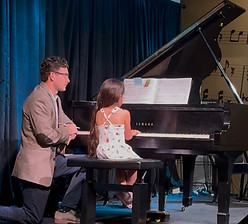
At The Purple Piano, our teaching philosophy is centered on the interconnectedness of music, mindfulness, and movement. Through multi sensory learning experiences, we strive to provide a music education that supports the whole student, regardless of age, ability, or background.
Why Music?
The word music comes from the Greek word mousikē, reflecting the long-held belief that music is one of humanity's highest forms of creative expression. Music is actually one of the few activities that engages the whole brain. It invites us to think, feel, create, listen, and move all at the same time. Because of this, music has a unique ability to strengthen both cognitive and social-emotional skills while providing a meaningful outlet for self-expression.
Music is also a powerful tool for connection. Across cultures, languages, and generations, people use music to communicate emotions, celebrate important moments, and build community. Music education teaches students how to listen, collaborate, and share something profound with others.
Learning an instrument also teaches students how to do hard things. Performing in a recital, conquering a challenging passage, or trying again after a mistake all teaches the brain how to be brave and persevere. These experiences help students develop resilience and a belief in their ability to tackle challenges both in music and beyond.

Why Mindfulness?


At its core, mindfulness is the practice of paying attention with awareness, curiosity, compassion, and non-attachment. It teaches us to notice our thoughts, emotions, and experiences without immediately judging or labeling them.
In music education, mindfulness encourages students to pause and reflect rather than react automatically. When a mistake happens, the goal is not to dwell on the fact that a mistake was made, but to become curious about why it happened and what strategies might help improve it. This shift from judgment to observation helps students develop problem-solving skills, resilience, and confidence.
A mindfulness-informed approach to teaching also recognizes that learning is not linear and that there is rarely a single path to understanding. Every student arrives at their lesson with unique experiences, emotions, and needs. By collaborating with students throughout the learning process, teachers can create an environment where students feel safe to explore, take risks, and make mistakes.
Perhaps most importantly, mindfulness teaches students to value and enjoy the process of learning rather than focusing solely on the outcome. This mindset is essential for developing healthy practice habits and cultivating perseverance.
For musicians, mindfulness can also take many practical forms, including developing awareness of posture and bodily tension, maintaining freedom of breath, managing performance anxiety, collaborating as a group, and listening inquisitively and attentively.
Why Movement?
Movement is a fundamental aspect of music. Humans are born with an innate ability to feel rhythm within the body. When children are exposed to music and movement at an early age, they naturally bounce, march, clap, and dance, further developing this embodied sense of rhythm.
Using movement to experience musical concepts such as rhythm, tempo, phrasing, and expression is key to connecting our bodies with the music we create. Engaging the body in music learning allows students to truly embody music rather than simply think about it, making musical concepts more accessible, memorable, and meaningful.


Movement also develops fine and gross motor coordination, body awareness, balance, and self-regulation. These skills help musicians play with greater ease and expression while also supporting healthy movement patterns that extend well beyond music.
Finally, movement provides yet another pathway for learning. Not all students learn best by sitting still and many need movement breaks. Movement within the context of music can take many forms such as stomping rhythms, moving to the tempo, conducting patterns, stretching, and functional-based activities.
How It Comes Together: Multi Sensory Learning

At the intersection of music, mindfulness, and movement is a teaching approach known as multi sensory learning.
Educational research has shown that students often retain and understand information more effectively when multiple senses are engaged throughout the learning process. Rather than relying solely on reading, listening, or memorization, multi sensory learning activates multiple neural pathways simultaneously. This can look like combining speaking and movement, listening and reading, visual and tactile experiences, and so on within a single activity. Activities often incorporate movement, manipulatives, games, and experiential learning opportunities to help students actively engage with new concepts, rather than passively receive the information.
By incorporating multiple pathways for learning, teachers can foster learning experiences that are more accessible to and successful for a wide variety of students. Through multi sensory learning, students can develop a deeper understanding of concepts, improve retention, and become more active participants in their own learning.
What This Looks Like At The Purple Piano
Multisensory learning in a music lesson can look different across students and even from week to week with the same student. Our lessons are designed to be flexible and responsive, meeting students where they are while adapting to their individual strengths, interests, and goals.
Examples of multi sensory learning at The Purple Piano include differentiating between high and low sounds through dramatic play, moving around the room to experience different tempos, counting and clapping rhythms, playing games to reinforce note reading, using manipulatives to visualize rhythmic patterns, or incorporating colors and visual cues to identify musical sequences.
Sure, it's often fun and games—quite literally—but these experiences are carefully designed to support learning in ways that resonate with each individual student. Learning music should be engaging and enjoyable. While the brain learns through repetition, repetition does not have to be boring. When students are excited, curious, and actively involved in the learning process, they are more likely to develop a deeper understanding of musical concepts and a lasting love of music.
At The Purple Piano, our lessons are designed to balance challenge, creativity, and enjoyment without creating unnecessary overwhelm. We believe that learning happens best when students feel safe, engaged, embodied, and empowered. While each teacher brings their own personality and teaching style to the lesson, our shared goal is to provide learning experiences that support musical (and personal) growth.
Students may follow a structured curriculum, focus on specific genres or repertoire, develop improvisation and composition skills, or simply explore music in a way that feels meaningful to them. Technical development, musicianship, creativity, and self-expression are all valued parts of the learning process.
We believe that learning to read music is an important and valuable skill, but it is not the only entry point into music. Just as children learn to speak long before they learn to read and write, students can develop a deep understanding and love of music through listening, movement, creativity, exploration, and play.
There is no single correct path to becoming a musician.


Why Invest In Music Education?
Music education is an investment in far more than the ability to play an instrument. It provides opportunities to develop confidence, resilience, discipline, self-awareness, and the ability to find joy in doing difficult things. It teaches students how to persevere through challenges, communicate with others, and express themselves in ways that words alone often cannot. Learning music is an ongoing process that is meant to be savored.


At The Purple Piano, we believe that music is a vehicle for personal growth. When combined with mindfulness, movement, and multisensory learning experiences, it becomes a powerful tool for helping students discover not only what they can play, but who they can become.
Ultimately, our goal is not simply to develop skilled musicians. We strive to cultivate curious minds, compassionate hearts, resilient learners, and confident individuals. We believe that music education has the power to shape not only better musicians, but better humans.
